Our goal
The goal of the foundation is the conservation and sustainable management of nature and natural resources in Suriname, whether or not in collaboration with national and international organisations, all in the broadest sense of the word, to the extent permitted by law.
The foundation tries to achieve its goal by, inter alia:
- Conducting or commissioning scientific research in the coastal zone, including the mangrove belt, savannah and other biotopes, the maritime area, as well as in the interior of Suriname;
- Advising government and governmental organisations, both solicited and unsolicited, to report unusual situations or acute problems;
- Evaluating and disseminating information and data on these ecosystems through national and international publications, presentations, seminars, workshops and websites in order to raise awareness of the social, economic and environmental- ecological importance of these ecosystems;
- Initiating and maintaining contact with national and international non- governmental organisations (NGOs) and, explicitly, with the various ministries;
- Acquiring funds for and providing financial support to persons and organisations pursuing projects and activities with an equal or similar purpose;
- Collaborating with organisations and bodies, both national and international, which pursue, directly or indirectly, the same or similar aims;
- Using all legal means which are conducive to achieving this goal;
MANGROVES IN SURINAME
In Suriname six (6) mangrove species occur on the mud coast, in the northern part of our country; two (2) savanna species are known from white sand savannas but also from granite rock savannas also known as Inselbergs. Along our north Atlantic coast two black mangrove species were recorded, also known as Parwa with the Latin names Avicennia germinans L. en Avicennia schaueriana (Stapf & Leechm.). In addition, three Red mangrove species or Mangro were recorded, having the Latin names Rhizophora mangle (L.), Rhizophora racemosa (G.F.W.Mey) and Rhizophora harrisonii (Leechm.), the latter might be a putitive hybrid, and the white mangrove or Akira, Laguncularia racemosa (L.Geartn.f.). These six mangrove species belong to three plant families, the Avicenniaceae, Rhizophoraceae and Combretaceae, respectively.

White mangrove with small white flowers
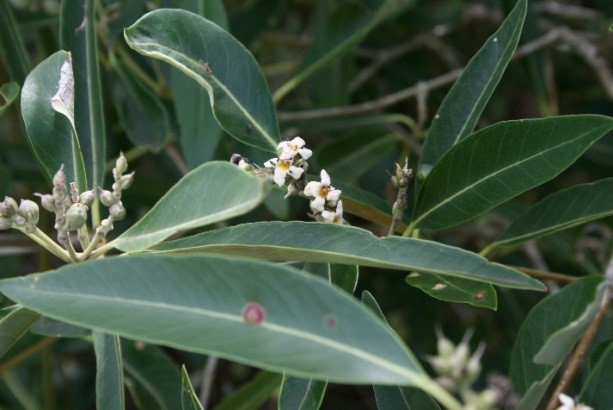
Parwa flowering
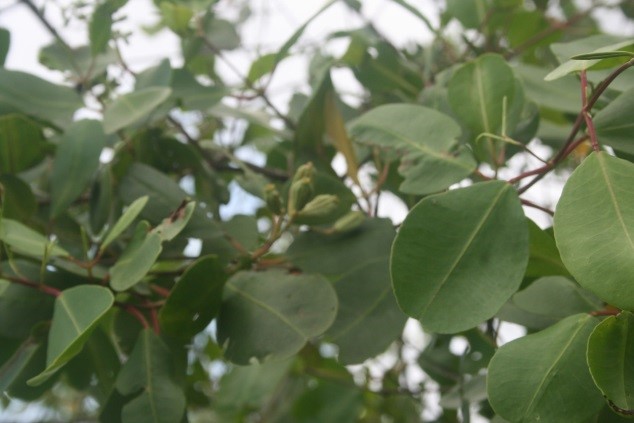
White mangrove (Akira) with seeds
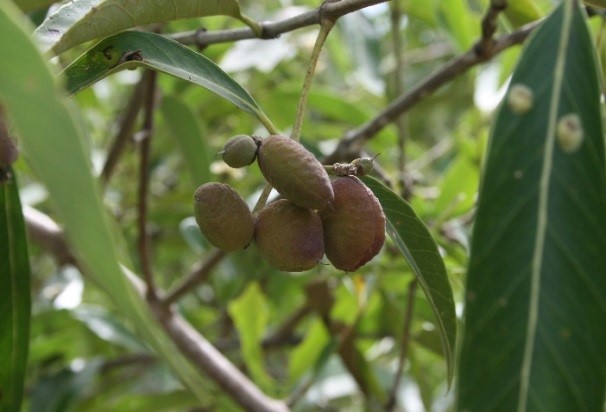
Parwa embryo’s (seeds)
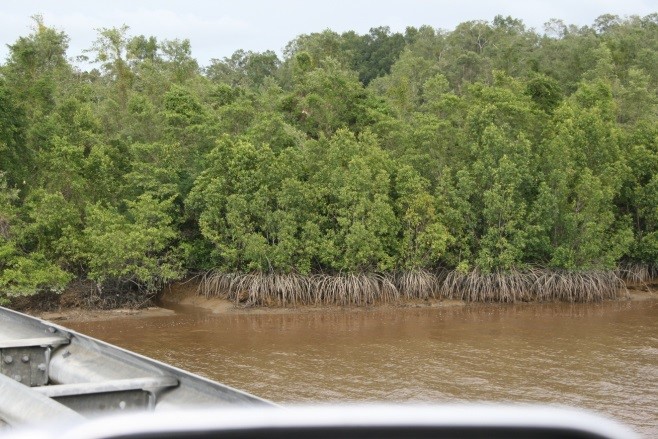
Mangro (Coppename riverbank)
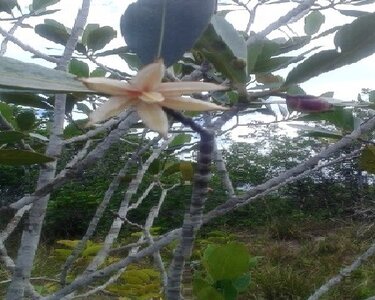
Savanna mangrove

Measuring photosynthesis from Parwa in Coronie
The mud mangroves and savanna
mangroves differ from each other:
1. The first ones have an extensive
root system which enables them
to root well into the mud
preventing them from capsizing
easily;
2. The tolerate sea water which
many other plants are unable to
do. It is important to know that
every mangrove species have
specific characteristics that
differ from other mangrove
species;
The propagules (seeds) are
already developed while still on
the tree. They may float for a
month or longer in the sea water
while further development of the
embryo takes place. When they
have reached stabile mud the
sometimes already developed
roots penetrate into the mud
and the plant roots.
On the other hand, savanna
mangroves do not need water
for seed/propagule dispersion.
The seed bearers burst open
forming a star-like shape and
the sticky orange colored seeds
become visible for birds to pick
and disperse.